22 July 2026
Queensland’s rainforest frogs were hit hard by chytrid fungus in the 1980s and 1990s, causing the likely extinction of six species and significant declines of others.
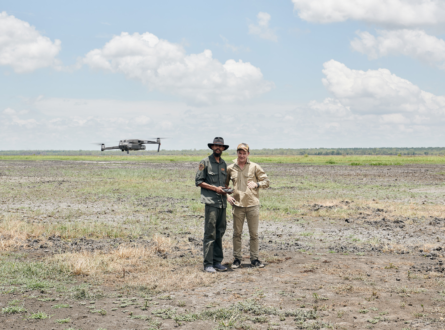
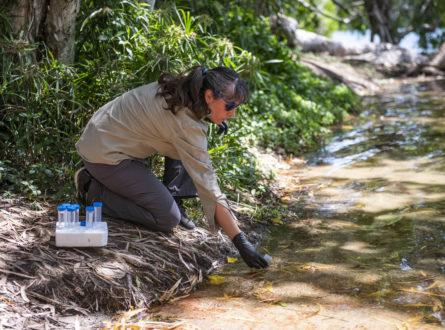
The search for the three threatened frog species used genetic traces (known as environmental DNA or eDNA) of the frogs in waterways of the Wet Tropics.
Dr Cecilia Villacorta-Rath, head of TropWATER’s Environmental DNA Laboratory, led the study in collaboration with JCU’s Prof Conrad Hoskin and Prof Damien Burrows, Director of TropWATER, with funding through the National Environmental Science Program.
“Environmental DNA helps us find endangered populations without having to check every river and stream to spot individuals directly,” said Dr Villacorta-Rath. “This is a significant strength compared to traditional surveys that require long hours in remote rainforest areas.”
The study demonstrated that environmental DNA techniques can successfully detect frog populations using water samples collected as far as 22 kilometres downstream.
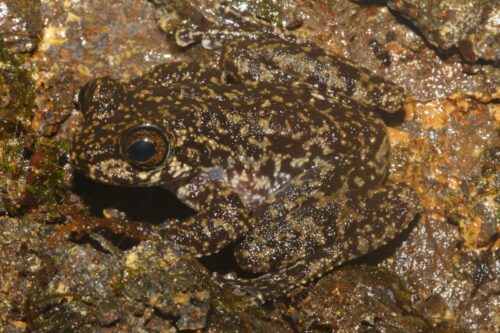
The Waterfall Frog (Litoria nannotis). Photo: DH Fischer and Conrad Hoskin.
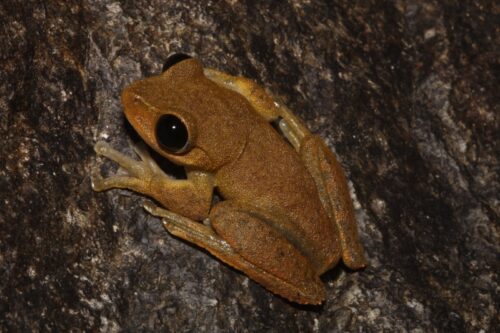
Australian Lace-lid Frog (Litoria dayi). Photo: DH Fischer and Conrad Hoskin.
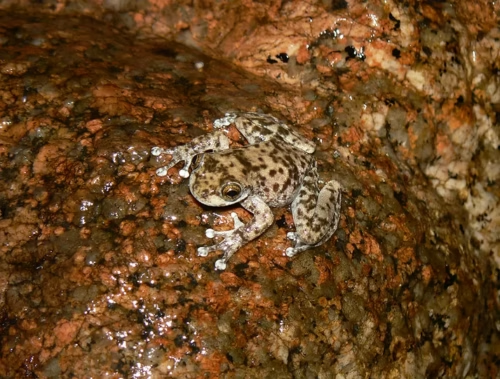
Armoured Mistfrog (Litoria lorica) Photo: Conrad Hoskin
TropWATER is leading advances in eDNA science to address ecological challenges in the Australian tropics. Projects like this are a valuable first step towards targeted conservation and management by using genetic clues to identify where at-risk populations may be found.
Two species – the Waterfall Frog (Litoria nannotis) and Australian Lace-lid Frog (Litoria dayi) – were detected across the study area, including in streams where no observations had been recorded since the widespread declines.
The Armoured Mistfrog (Litoria lorica) was detected in just one location in the Carbine Tablelands, where the only known population of these Critically Endangered frogs is found.
“The good news is Litoria dayi and Litoria nannotis were more widespread than we thought – they’re bouncing back,” Dr Villacorta-Rath said.
The situation for the Armoured Mistfrog is not as good.
“We hoped to find overlooked populations tucked away in the mountains of its historic range,” said Prof Hoskin, “but the eDNA results support the field surveys showing that almost certainly only a single population survived the catastrophic impacts from chytrid disease.”
The study was published this month in Conservation Science and Practice.
This project was supported with funding from the Australian Government under the National Environmental Science Program.
This story was originally published by JCU TropWATER.
Want to know more about the Resilient Landscapes Hub's activities and our research into practical solutions to environmental problems? Stay informed about activities, research, publications, events and more through the Hub newsletter.
"*" indicates required fields