2 October 2025
Game changing new research has measured individual tree heights across 3.1 million hectares in the New South Wales Northern Rivers Region, revealing a level of detail not captured before including old growth forests and the tallest tree at 81 metres.
In the study published in Australian Journal of Botany, advanced mapping techniques using LiDAR and computational power have revealed a detailed assessment of forest structure at the single-tree level over large geographic extents of the Northern Rivers region. LiDAR (Light Detection and Ranging) uses laser light to measure distances to create detailed three-dimensional (3D) models of the landscape, including trees.
Lead author on the National Environmental Science Program Resilient Landscapes Hub project, Dr Patrick Norman from Griffith University said the advanced mapping techniques allowed them to use publicly available Airborne Laser Scanning data to model forest canopy height and individual trees across a 3.1 million hectares, at a level of detail that has not been achievable until now.
“This has allowed us to map the forest canopy in incredible detail capturing more than 180 million individual trees across this huge area,” Dr Norman said. “We have been able to identify the tallest trees, including an 81 metre flooded gum (Eucalyptus grandis) and a 77 metre hoop pine (Araucaria cunninghamii). This has also allowed us to understand a better picture of where the remaining areas of old growth forest are, which will be important for conservation efforts.”
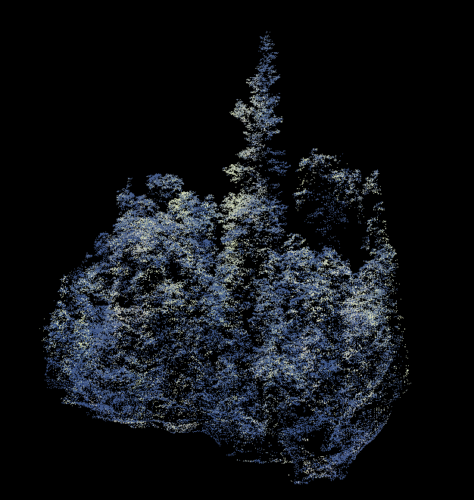
LiDAR image of 77 metre hoop pine (Araucaria cunninghamii) thought to be the tallest rainforest tree in Australia. (Norman 2025)
The analysis of tree heights across different vegetation types and land uses showed the tallest trees were found in wet sclerophyll forests, in areas of native forest designated for nature conservation or timber production.
The tallest tree, the flooded gum, and the fig with the largest canopy spread are both located in Toonumbar National Park and the very tall hoop pine is in Border Ranges National Park, close to the Queensland border. Both of the tallest trees are located within very remote areas of the park making them difficult to access.
“This information provides valuable insights into the influence of environmental and human impacts on tree heights, which could be used to inform management strategies and conservation efforts within the region and can also be applied to other forested landscapes,” Dr Norman said. “Identifying where the old growth forests are could also help us to understand where the native wildlife might live including endangered greater gliders and powerful owls as well as the many other species that rely on those old trees.”
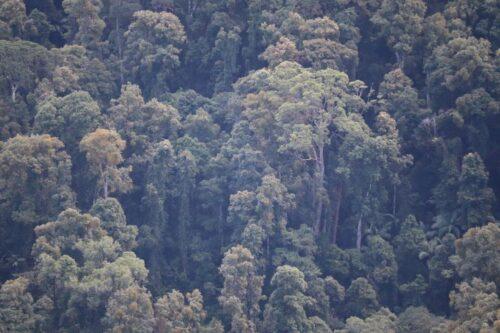
View of Border Ranges National Park. Photo by Patrick Norman. A 77 metre hoop pine (Araucaria cunninghamiiI), thought to be the tallest rainforest tree in Australia, was located in old growth forest in a remote part of the Border Ranges National Park.
This research is part of a project to develop climate change adaptation plans for the Northern Rivers region of New South Wales and the Wet Tropics of Queensland. Both regions are home to many threatened species and ecological communities and contain a diverse range of land uses and protected areas, including significant wetlands, national parks, World Heritage Areas, Indigenous Protected Areas and Indigenous Land Use Agreements. They are also places of rapid change: in a three-year period in the Northern Rivers region, unprecedented drought has been followed by bushfires and floods in rapid succession.
Want to know more about the Resilient Landscapes Hub's activities and our research into practical solutions to environmental problems? Stay informed about activities, research, publications, events and more through the Hub newsletter.
"*" indicates required fields