23 November 2025
A major national research initiative under the National Environmental Science Program’s Resilient Landscapes Hub is shedding new light on what “success” looks like in natural resource management (NRM) across Australia—revealing that ecological, social and economic achievements are deeply interconnected, yet often measured in isolation.
The project led by University of Tasmania Professor Natalie Stoeckl with Postdoctoral Research Fellows Dr Bassie Limenih and Dr Amber Tsai is the first of its kind to systematically unpack how different stakeholders—farmers, volunteers, coordinators, landholders, experts, and policymakers—define and experience success in conservation, restoration, and land management programs.
Understanding Success Across a Complex NRM Landscape
NRM efforts in Australia involve a wide range of actors, from on-ground volunteers and farmers to project managers, expert advisors, and federal funding bodies. These actors work at multiple scales and use different forms of data to make decisions, creating a complex system in which success can look very different depending on one’s role and objectives.
The project focuses on four key research areas:
A New Conceptual Model for Linking People, Place and Outcomes
A review of existing research revealed that social studies typically examine why people choose to participate in NRM, while ecological studies focus on biophysical outcomes—leaving the connection between the two underexplored.
To address this gap, the research team developed a new conceptual model that integrates pre-existing social and environmental conditions, people’s intentions to participate, on-ground actions, and ecological, social and financial outcomes. This framework is now being tested through a national survey co-designed with project partners.
National Survey Reveals What Australians Value—and Achieve—in NRM

The project surveyed 249 participants across Australia, representing a broad cross-section of NRM stakeholders:
The strong national distribution demonstrates widespread engagement and diverse perspectives.
What Activities Are Most Successful?
Respondents reported high participation and high perceived success in:
Activities seen as least successful—and least practiced—included planting non-native trees and closing water points.

Ecological Goals: Highly Valued, Harder to Achieve
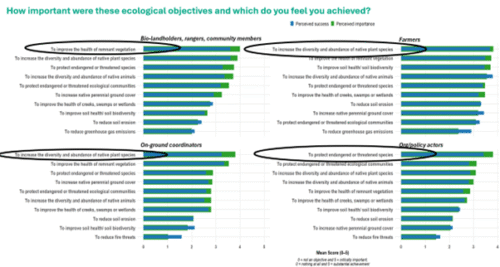
Across all groups, ecological objectives such as protecting endangered species and improving remnant vegetation were rated as highly important. However, many respondents reported that these goals were difficult to achieve, difficult to observe, or took a long time to achieve, indicating a persistent gap between intention and outcome.
Social and Cultural Goals: Strong Positive Spillovers
Personal and social objectives—such as building knowledge, sharing information, and improving wellbeing—were also highly valued. Notably, respondents often reported greater success than importance in areas like community connection and personal wellbeing, suggesting that NRM activities deliver powerful unintended social and personal benefits.
Economic Goals: Particularly Important for Farmers
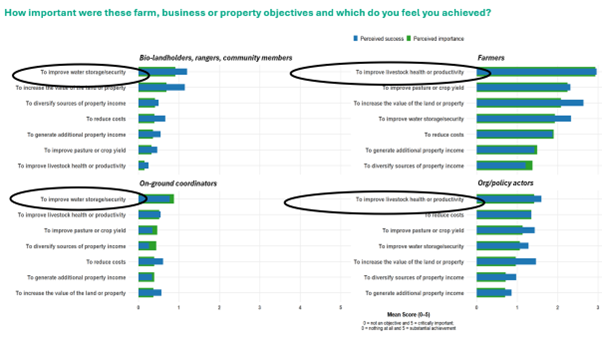
Productivity-related outcomes—water storage, land value, crop and pasture yield—were considered important by some groups, with farmers reporting the highest levels of success in meeting these goals.
Barriers and Enablers: What Helps—and Hinders—NRM Success?
Widely available supports included:
Least accessed supports included:
The limited access to Indigenous knowledge highlights a key area for improvement in program design and collaboration.

When asked about external factors affecting engagement, participants identified:
This finding underscores the disruptive effect of policy instability on long-term conservation work.
Next Steps: Integrating Ecological Data and On-Ground Assessment
The research team is now integrating survey data with ecological and socioeconomic datasets to understand how local context shapes outcomes. In Tasmania and New South Wales, ecologists are conducting site assessments to compare people’s perceptions of success with actual ecological conditions.
The project aims to help regions and organisations:
Toward a More Holistic Understanding of NRM Success
By bringing together ecological science, social research, and the lived experience of people across Australia, the project is creating a clearer picture of what makes NRM initiatives work—and how to design programs that deliver benefits for landscapes and communities alike.
Link to full presentation deck
The National Environmental Science Program Resilient Landscapes Hub is funded by the Australian government to provide research to inform management of Australia’s terrestrial and freshwater habitats to promote resilience and sustainability
Want to know more about the Resilient Landscapes Hub's activities and our research into practical solutions to environmental problems? Stay informed about activities, research, publications, events and more through the Hub newsletter.
"*" indicates required fields
