26 November 2025
A new study examining the United Nations System of Environmental-Economic Accounting—Ecosystem Accounting (SEEA-EA) outlines how the framework can more meaningfully reflect First Nations worldviews, values and relationships with Country.
The SEEA-EA is now used or being adopted in more than 130 countries to track ecosystem extent, condition and the services nature provides. Yet current approaches largely reflect Western scientific and economic perspectives.
Co-author, Associate Professor Diane Jarvis from James Cook University, said the study highlights that respectful partnership with First Nations groups—and codesign of all stages of the accounts—is essential if the system is to monitor Country in ways that matter to Traditional Owners.
“For First Nations peoples, Country is family, identity and responsibility,” Associate Professor Jarvis notes. “Accounting systems must reflect that interconnected worldview if they are to be meaningful and useful.”
The study proposes practical steps to enhance the relevance and accuracy of ecosystem accounts for First Nations groups:
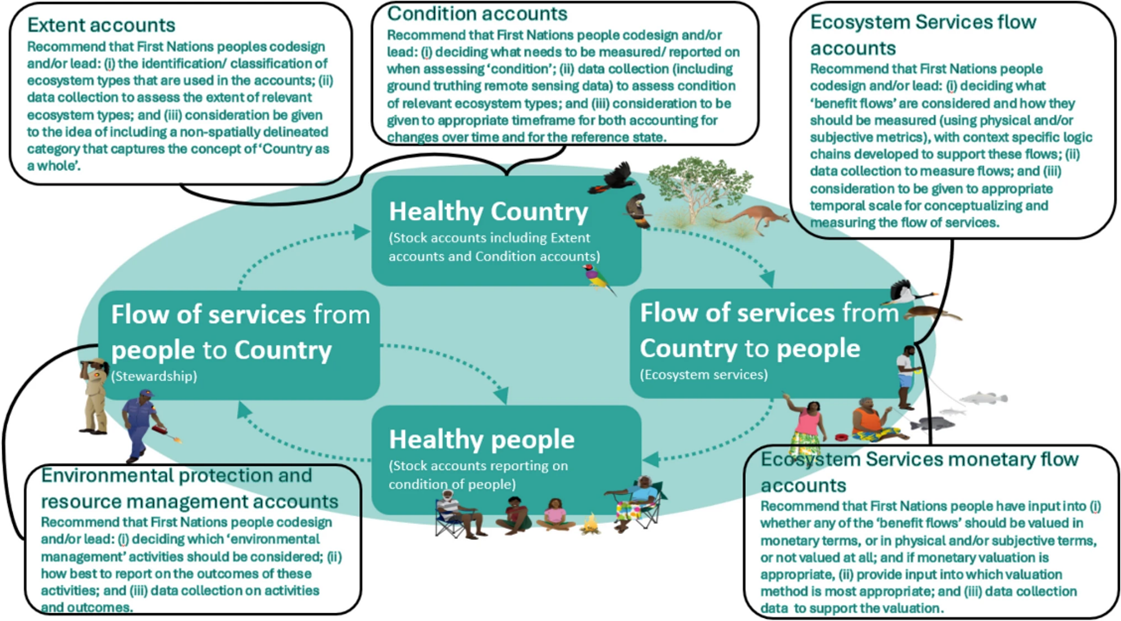
First Nations perspective approach to the SEEA-EA. Symbols courtesy of the NESP Resilient Landscapes Hub, nesplandscapes.edu.au
The study emphasises that building accounts “by” First Nations—not simply “for” them—supports self-determination, strengthens Caring for Country, and can lead to better policy, environmental outcomes and wellbeing. They recommend piloting these approaches with diverse First Nations groups so future ecosystem accounts can genuinely reflect multiple knowledge systems.
The proposed approaches are currently being trialled with First Nations groups from different environmental contexts, one from northern Queensland’s savannah and another from the southern coast of Western Australia, in a project supported by the NESP Resilient Landscapes Hub.
The NESP project aims to identify an approach that aligns with international commitments including the Kunming–Montreal Global Biodiversity Framework, the UN Declaration on the Rights of Indigenous Peoples, and recent national initiatives recognising the importance of Indigenous knowledge in environmental decision-making.
Want to know more about the Resilient Landscapes Hub's activities and our research into practical solutions to environmental problems? Stay informed about activities, research, publications, events and more through the Hub newsletter.
"*" indicates required fields