28 November 2025
A ground-breaking collaboration between James Cook University (JCU), the University of Tasmania (UTAS), and four South East Queensland councils is helping Australia move closer to its “30 by 30” conservation target — protecting 30 per cent of the nation’s biodiversity by 2030 — by empowering private landholders to take action on their own properties.
The National Environmental Science Program (NESP) Resilient Landscapes Hub project led by Associate Professor Diane Jarvis at JCU and Dr Vanessa Adams at UTAS explores how partnerships with landholders can strengthen biodiversity conservation while improving community wellbeing.
Conservation Ecologists and NESP researchers at JCU Michael Tervo and Maaike Hofman have been conducting the study on South East Queensland properties. They say landholders play a crucial role in achieving Australia’s ambitious biodiversity targets.
“Private landholders are vital in conserving biodiversity in addition to state and federal governments management of protected areas,” Michael Tervo said.
“By engaging with landholders, we can conserve biodiversity on private land where many endangered species live, not just within national parks,” Maaike Hofman said.
The project, co-designed by NESP researchers from JCU in collaboration with Moreton Bay Regional, Logan City, City of Gold Coast and Scenic Rim Regional councils and Land For Wildlife South East Queensland, investigates how different levels of engagement can influence conservation outcomes and social connection.
Landholders are encouraged to contribute to iNaturalist, a global citizen science platform where anyone can record and share observations of plants and animals. Workshops and online sessions guide participants on the various ways of detecting, identifying, and recording biodiversity on their properties.
“Engaging through platforms like iNaturalist is an amazing way that anyone, no matter their capacity, can support conservation in Australia and around the world,” Michael Tervo said.

Landholders are encouraged to contribute to iNaturalist. Photo: Nicolas Rakotopare
The study also uses trained detection dogs from the University of the Sunshine Coast on private properties to locate threatened species such as greater gliders, koalas, and quolls. The information from the detection dog is followed up with researchers and landowners conducting spotlight searches to find those individual greater gliders. The findings are helping to map important habitats and inspire landowners to protect those areas.

Trained detection dog Austin with handler Marcus from University of the Sunshine Coast. Photo: Nicolas Rakotopare
The greater glider is found in South East Queensland across the four council regions that are participating in the project including on private Land for Wildlife properties within this region.
“The greater glider is a really good species to focus conservation efforts on because it’s endangered and it’s cryptic, people may not even know they have them in their backyard and they’re also a really good indicator species,” Maaike Hofman explained. “Greater gliders require specific habitat like old growth trees with minimal disturbance, so trying to improve pockets of habitat remaining to that standard and bringing the greater gliders back will ultimately protect a lot of other species as well.”
City of Gold Coast Conservation Officer Todd Burrows said the partnership has been invaluable.
“Hopefully the research will demonstrate scientifically what we’ve long believed — that working with private landholders makes a real difference for conservation,” Mr Burrows said.
Scenic Rim Regional Council wildlife officer Catherine Madden described the collaboration as having strengthened local connections.
“Neighbours have started talking to each other, sharing iNaturalist stories,” Ms Madden said. “We’ve even detected greater gliders in places we never would have found without the detection dogs.”
Science Rim landowner Darryn Bell, who joined the project after spotting gliders near his property, said the experience had deepened his appreciation for conservation.
“We didn’t expect to have greater gliders here,” Darryn said. “The project has really opened our eyes. The more we learn, the more attached we feel to our land. It makes us want to do more to protect it.”
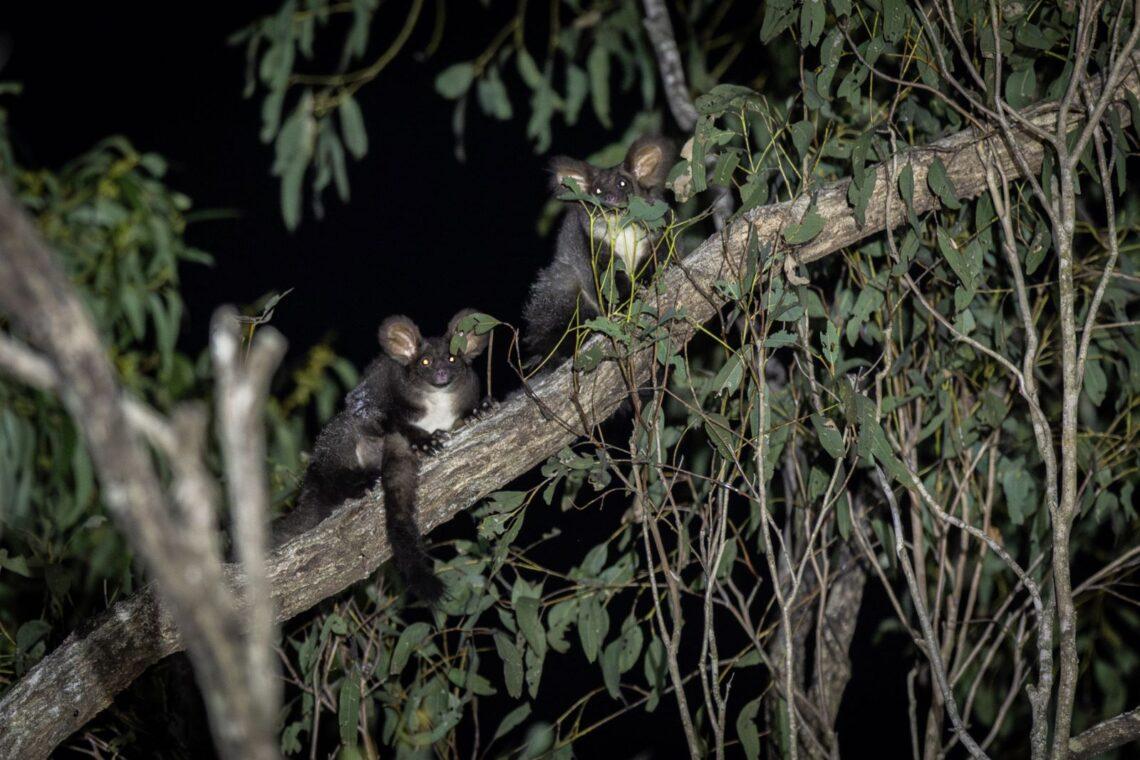
Greater gliders found on private land under spotlight. Photo: Nicolas Rakotopare
The project also includes the development of tailored educational resources for Land for Wildlife members, including fact sheets, infographics, and simplified field guides focused on the greater glider and other species. These tools are designed to motivate and upskill landholders to implement practical conservation actions on private land.
Researcher Maaike Hofman said one of the most powerful outcomes has been seeing personal relationships grow between landholders and Land for Wildlife officers.
“What starts as a professional relationship often becomes a friendship built on shared passion for biodiversity,” she said. “That human connection is a key driver of ongoing conservation.”
With Australia’s biodiversity facing increasing pressures, projects like this highlight the crucial role that private landholders and their local councils play in shaping a sustainable, connected landscape for the future.
The National Environmental Science Program Resilient Landscapes Hub is funded by the Australian government to provide research to inform management of Australia’s terrestrial and freshwater habitats to promote resilience and sustainability.
Want to know more about the Resilient Landscapes Hub's activities and our research into practical solutions to environmental problems? Stay informed about activities, research, publications, events and more through the Hub newsletter.
"*" indicates required fields
