17 December 2025
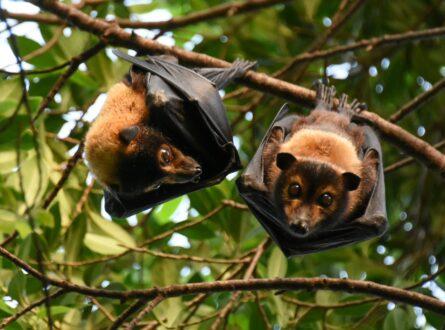
Indigenous rangers and scientists are combining Traditional Knowledge with cutting-edge technology to monitor populations of the endangered Spectacled Flying-fox — a crucial long-distance pollinator and seed disperser for Wet Tropics rainforests.
Rangers from 16 Traditional Owner groups across the Wet Tropics region are identifying roost sites, counting flying-foxes and recording data using digital tools. Information collected through these on-ground counts is being compared with thermal drone imagery, and AI is being developed by researchers at James Cook University (JCU) to count the bats in the images.
The science program is part of a broader effort to help the species to recover after catastrophic population declines over the past two decades. By combining Indigenous rangers’ local knowledge with new drone and AI technology, researchers are developing more accurate and efficient ways to track flying-fox numbers across northern Queensland.

Yirrganydji Rangers Manoah Wallace, Taylah Mitchell and Jayvan Singleton with Dr Andrew Dennis and National Environmental Science Program Researcher at JCU Emmeline Norris. Photo supplied by Terrain NRM
Terrain NRM’s Dr Andrew Dennis said the program, funded by the Australian Government, is building a clearer picture of how the species is faring.
“Population monitoring is essential when we’re trying to recover an endangered species,” Dr Dennis said.
“It helps us to understand how populations are changing, why they’re declining or recovering, and whether conservation actions are working. Rangers are collecting critical data on roost locations and foraging behaviour, which allows us to pinpoint high-risk areas and plan interventions to reduce threats.”
Using scientific survey methods, rangers map each roost on their Country and count how many bats are present. The information is recorded in a mobile app and collated to build a regional picture of population health.
Spectacled Flying-fox numbers plummeted from 250,000 to 75,000 between 2004 and 2016 across Far North Queensland, from Ingham to Cape York. The 2018 heatwave killed another 23,000, and modelling predicts further declines without intervention.
Dr Dennis said early trials of the drone and AI system with the National Environmental Science Program show promising results.
“The technology is capable of detecting roosting bats with high accuracy, even under dense rainforest canopy,” he said.

Drone remote controller showing spectacled flying-fox hotspots. Photo: Emmeline Norris
While early data suggests populations may be improving since the 2018–19 heatwaves, Dr Dennis said continued action is vital.
“To ensure recovery continues, we need to reduce as many causes of mortality as possible and protect safe habitat areas. Data collected by Indigenous rangers is helping us identify critical habitat for protection and rehabilitation.”
Terrain NRM and partners have inspected 40 priority sites across the Wet Tropics. The main habitat threats identified include land clearing and invasive weeds including exotic plants escaping from people’s gardens.
“We’ll be undertaking targeted habitat improvements — including revegetation, weed management, and supporting the establishment of reserves for key roost sites,” Dr Dennis said.
“It takes a team effort to recover an endangered species. By working closely with Indigenous rangers, the Spectacled Flying-fox Recovery Team, and research partners, we’re bringing together science, culture and community to help this species bounce back.”
For more information about Spectacled Flying-foxes go to www.terrain.org.au/spectacled-flying-foxes-faqs
This project is funded by the Australian Government under Saving Native Species and delivered by Terrain NRM as member of the Commonwealth Regional Delivery Partners panel. The thermal drone project is supported with funding from the Australian Government under the National Environmental Science Program.
This story was originally published by Terrain NRM.
Want to know more about the Resilient Landscapes Hub's activities and our research into practical solutions to environmental problems? Stay informed about activities, research, publications, events and more through the Hub newsletter.
"*" indicates required fields