26 February 2026
Thermal drones have the potential to outperform ground-based surveys for detecting threatened rainforest species according to a review of international research.
The study published in Biodiversity and Conservation examined 38 global studies between 2018 and 2025 that used thermal drones to detect wildlife in dense tropical forests by their heat signatures.
The review found many studies were at the pilot or proof-of-concept stage. However, consistent patterns are beginning to emerge.
Study coauthor PhD candidate Emmeline Norris said thermal drones have been found to perform particularly well for arboreal mammals – especially primates – when flight protocols are carefully matched to species behaviour and environmental conditions.
“Thermal drones can achieve more accurate results than traditional ground-based approaches, particularly when animals are higher in the canopy, partially concealed by vegetation, or active during cooler periods when the thermal contrast between the animal and its surroundings is greater,” Ms Norris said.
“While early research focused almost exclusively on primates, more recent studies have seen feasibility trials expand to include bats, marsupials, sloths, ungulates, elephants and birds.”
The review confirms that outcomes depend less on the technology alone and more on how it is deployed. Detection success is shaped by a combination of biological characteristics such as body size and activity patterns, environmental factors including canopy structure and ambient temperature, and technical decisions about flight height, speed and camera angle.
The study also identifies opportunities to support Indigenous-led monitoring programs. Indigenous peoples manage or hold tenure over more than one-third of the world’s remaining intact tropical forests.
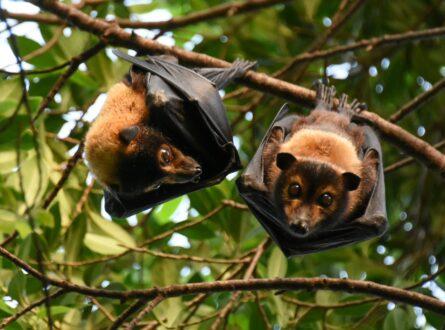
The review is part of a National Environmental Science Program (NESP) Resilient Landscapes Hub project led by Professor Susan Laurence from James Cook University. The NESP project aims to pilot the use of thermal drones with Indigenous rangers to monitor threatened spectacled flying-fox populations in north Queensland following extreme heat events.
“This review highlights that when co-designed and adequately resourced, drone-based monitoring programs can strengthen local technical capability while integrating cultural knowledge and respecting data sovereignty,” Professor Laurence said. “Sustained funding, training and ethical governance frameworks will be essential to ensure these technologies support long-term stewardship.”
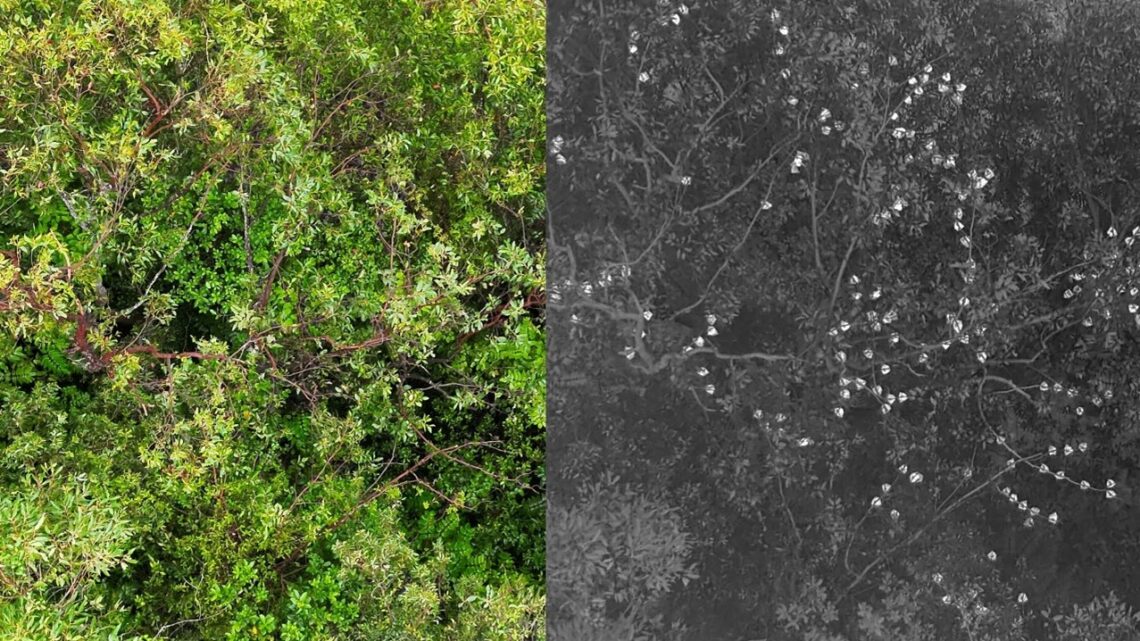
Thermal drones have proven effective in identifying spectacled flying fox roosts in inaccessible areas such as mangrove forests. Photo: Emmeline Norris.
The study concludes that, when embedded in clear management objectives and paired with appropriate validation methods, thermal drones can become a valuable tool for strengthening biodiversity monitoring in tropical forests.
The National Environmental Science Program Resilient Landscapes Hub is funded by the Australian Government to support research that strengthens the resilience and sustainability of Australia’s terrestrial and freshwater ecosystems.
Want to know more about the Resilient Landscapes Hub's activities and our research into practical solutions to environmental problems? Stay informed about activities, research, publications, events and more through the Hub newsletter.
"*" indicates required fields